


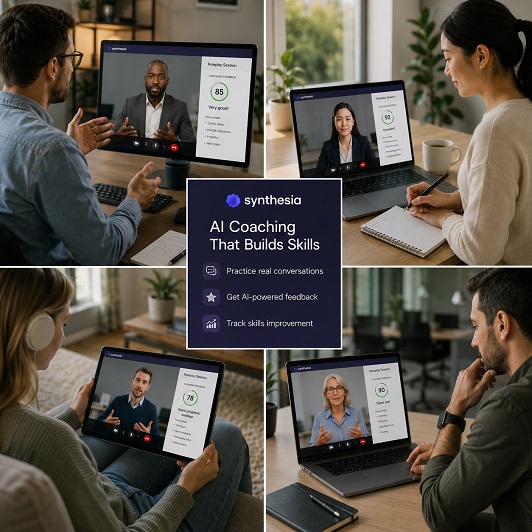
AI training company Synthesia has launched a new platform that allows employees to practise difficult workplace conversations with AI avatars that respond, challenge and coach them in real time, marking a significant move beyond creating training content towards measuring whether people have actually learned new skills.
What Has Been Announced?
For several years, UK-based Synthesia has been best known for helping organisations create AI-generated training videos quickly and at relatively low cost. Those videos have been widely adopted by businesses looking to reduce the time and expense involved in producing learning materials.
The company's latest launch, however, moves well beyond video production. For example, its new platform, called Roleplay Sessions, allows employees to rehearse realistic workplace conversations with interactive AI avatars. Rather than simply watching training videos, learners actively participate in simulated discussions covering situations such as sales calls, customer complaints, performance reviews, leadership conversations and difficult workplace interactions.
As Synthesia explains, learners can "practice real conversations with Interactive Avatars, get live coaching, and measure skills uplift."
The launch also represents the first product in a wider Sessions platform that Synthesia intends to expand into additional training and assessment scenarios over time.
From Watching To Practising
The thinking behind the new platform is actually pretty straightforward. Watching someone demonstrate a skill is rarely enough on its own to develop competence.
Instead, Roleplay Sessions places employees into realistic conversations where the AI avatar asks questions, challenges responses and reacts dynamically throughout the discussion. Learners can repeat each exercise as often as they like without worrying about making mistakes in front of colleagues or customers.
According to Synthesia, the goal is to move "from forgettable training to practice that makes people ready."
Unlike traditional roleplay exercises, which usually require managers or colleagues to give up time acting as customers or interviewers, AI makes unlimited practice available whenever employees need it.
Every learner also receives a consistent experience rather than one influenced by the coaching style or experience of an individual manager.
How AI Becomes The Coach
One of the most interesting aspects of Roleplay Sessions is that the AI's role does not end when the conversation finishes.
For example, after each exercise, an AI coach reviews the interaction, asks learners how they think they performed, scores the conversation against predefined skills criteria and provides detailed coaching on what worked well and where improvements could be made.
Synthesia describes the process simply: "The coach asks how you think it went before showing your score, then walks you through it."
Instead of producing a simple pass-or-fail result, the platform measures multiple competencies relevant to each role, allowing both employees and managers to monitor improvement over time.
The company says managers can "see who's improving, where the gaps are, and which skills actually drive performance" across individuals, teams and entire organisations.
Making Soft Skills Measurable
Perhaps the biggest change is that the platform attempts to measure skills that have traditionally been difficult to assess objectively.
Technical knowledge is relatively easy to test through exams or online quizzes. Communication, leadership, negotiation and customer service skills are much harder to evaluate consistently because they depend on judgement, confidence and interpersonal behaviour.
Roleplay Sessions attempts to make those qualities measurable by combining structured assessment criteria with detailed conversation analysis.
The platform can also be customised to reflect an individual organisation's products, customers, terminology, procedures and business scenarios, allowing employees to practise situations that closely resemble the conversations they encounter in their daily work.
Synthesia says organisations can create roleplays tailored by "industry, persona, personality, and language, so your team practices the exact people and situations they face."
A New Direction For Enterprise AI
The launch also reflects a broader change taking place across enterprise AI. Much of the first wave of business AI focused on generating content more quickly, whether that meant writing reports, creating presentations or producing training videos.
Increasingly, however, organisations are asking whether using AI actually improves business performance. Roleplay Sessions attempts to answer that question by linking learning directly to measurable outcomes. Instead of stopping once the training content has been delivered, the platform measures how well employees apply what they have learned and whether their performance improves through repeated practice.
The company also plans to expand the Sessions platform beyond workforce training into areas such as job interviews and candidate screening, suggesting AI coaching may eventually become part of the entire employee lifecycle rather than simply corporate learning.
What Does This Mean For Your Business?
For businesses, Synthesia's latest launch highlights how enterprise AI is evolving beyond automation and content generation towards improving workforce capability.
Many organisations have already adopted AI to create documents, presentations and training materials more efficiently. The next stage appears to be using AI to help employees practise, improve and demonstrate skills that directly affect business performance.
This could prove particularly valuable in areas such as sales, customer service and leadership, where consistent coaching is often difficult to deliver at scale. AI roleplay offers employees unlimited opportunities to rehearse important conversations while giving managers far greater visibility into where skills are improving and where further development is needed.
The wider significance is that enterprise learning itself may be changing. Rather than measuring how much training employees have completed, organisations are increasingly likely to measure whether people can actually perform the skills the training was intended to develop. As AI coaching becomes more sophisticated, businesses may find themselves investing less in simply delivering information and more in creating measurable improvements in employee performance.